
We’re entering what industry experts are calling the Great Decoupling: where your content can dominate the search engines but never actually attract clicks. You might have seen your impressions in the search engines increase or remain steady, but clicks have started on their own downward trajectory.
Featured snippets, AI overviews, voice-assistant responses and LLMs (think ChatGPT) have paved the way for zero-click SEO, reshaping the way users discover and interact with the information you provide. Suddenly, SEO has new layers that we’ve never had to navigate before.
Google’s roll out of AI overviews has led to a change in the way brands are seeing searchers behave when interacting with their content. The shift to zero-click search results has been building for years with the introduction of ‘People also ask’ boxes and featured snippets.
AI overviews provide searchers with answers instantly. They don’t have to click through the top search results to find the answer to their question because Google summarises them and provides the answer.

On one hand, AI overviews give you two chances to get eyes on your website for any given keyword, which means impressions have probably increased. On the other hand, clicks are decreasing because searchers no longer need to click through to your website to get an answer.
The good news is that if you’ve been building topical authority and rank highly already, it’s likely you’ll appear in AI overviews anyway as they pull from this content.
This is more likely to hit some search terms harder than others. For example, top of funnel keywords such as generic questions and how-tos are more likely to trigger AI overviews. Bottom of funnel keywords with high intent and brand keywords will be less impacted.
The Great Decoupling will impact SEO in a number of ways:
Traditional SEO isn’t dead but it’s changing.
In this new age of SEO, it’s not just Google we need to worry about. LLM SEO is now coming to the forefront too. You’re not just trying to rank in a search engine, you’re trying to get your content shown in AI results too. Large Language Models (LLMs) such as ChatGPT, Gemini and Claude are rapidly becoming information gatekeepers.
LLM SEO involves optimising your content so that it’s referenced in AI-generated answers. Google’s ranking algorithm pulls from its top results, whereas LLMs pull from huge training datasets and real-time web crawling and summarise and paraphrase information, so your brand could be either included and linked or completely invisible.
LLMs don’t rely on structured SERP rankings so keyword stuffing and optimised meta titles won’t help you here. You need to provide high-quality content that’s clear and proves your authority in your field.
Here’s an example of how LLMs are changing the search landscape and buyer’s journeys to purchase:
We recently spoke to a client who had a problem with his washing machine rattling on the cupboards and making a noise when in use. He asked ChatGPT what this problem was and discovered it was a common problem and not something wrong with his washing machine, as he had suspected. He then asked ChatGPT for three products that could help him solve this problem. ChatGPT provided him with links to three different pieces of foam that could stop his washing machine from making so much noise. The one he bought? The one with the product description that described how it could solve his exact problem…
For top of the funnel queries, such as questions and how-tos, create detailed blogs that answer the question and showcase your expertise. Not only will this help you to appear in search results, it will help you to become authoritative enough to be used in the AI generated results.
For bottom of the funnel queries, ensure you’re updating product and services pages with the problems your brand can help customers to solve. This will help you to appear in LLMs when they’re providing useful product links.
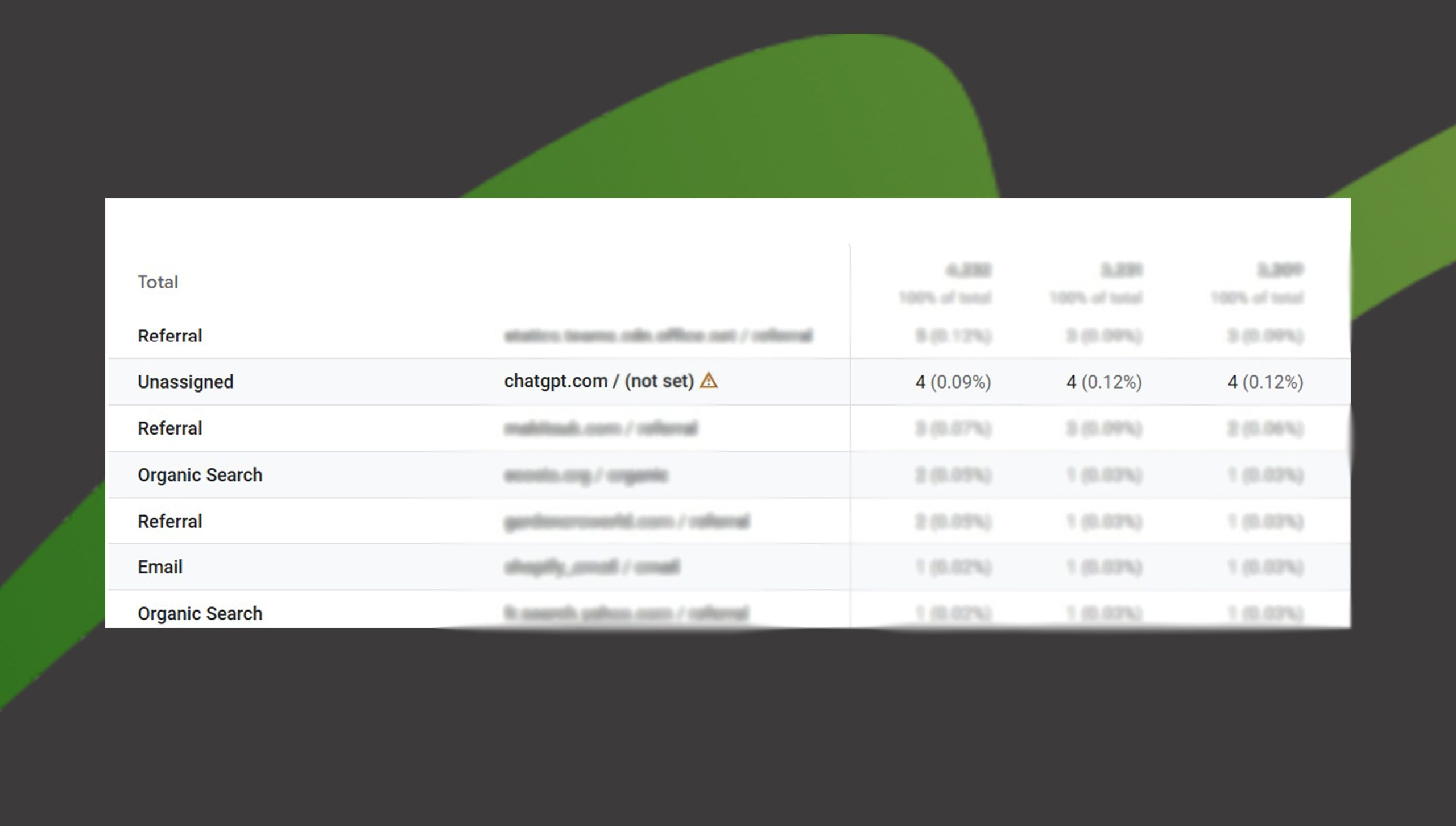
SEO isn’t dead. It’s evolving in the same way it always has. GEO (Generative Engine Optimisation) is the new term and means adapting your content for AI-driven search environments.
Here’s how you can adapt your SEO strategy to stay ahead:
Traditional metrics, such as organic traffic, bounce rate and CTR, will no longer give you an accurate picture of how your SEO strategy is performing, so you’ll need to reevaluate how you measure impact.
Alongside these metrics, start tracking the places in which your content appears in AI-driven results. Having visibility of this will allow you to track which pieces of content are effectively feeding these engines and where you need to do additional work to fill in the gaps.
Generic content can be easily replaced by AI, but expertise in your niche isn’t as easy to replace. If your content repeats the same information as other sites, it’s easier for AI tools to blend a number of pieces of content from various sources together. However, if you provide original research, statistics or an expert quote, this is much harder to replicate and helps to set you apart from others.
For the best results, your content needs to be clear, trustworthy and provide users with the answer they want quickly.
Create topic clusters or content hubs centred around what you do and how you do it. Make sure you answer your potential customer’s questions and provide authoritative, expert advice and knowledge.
This helps to build your authority and trustworthiness, and increases the chances of AI models and Google picking up your content.
If users search specifically for your brand, Google is less likely to intervene. Search engines and LLMs use brand authority to determine whether or not you are a trusted source online. If your brand appears to be well known, cited by others and respected for the authority you provide, you’re more likely to be cited in AI-generated results.
The future of SEO isn’t just limited to Google. LLMs and modern users are sourcing answers from a range of channels so think about this when creating content. Try and position your content so that it provides the answer that Google is looking to generate for its users.
In addition, thinking about how you can update product and services pages based on the different uses and applications they offer can help when it comes to appearing in LLMs for users looking to make a purchase.
The Great Decoupling marks a turning point for SEO. Ranking well no longer guarantees clicks and creating content no longer ensures visibility in the way it used to.
SEO isn’t dead, we just need to find different ways to get seen.
Success isn’t just about search positions or web traffic. It’s about being a trusted voice in your niche. It’s about creating content so useful that it’s quoted, cited and surfaced across Google, ChatGPT or in a LinkedIn post. It’s about showing up wherever your audience is asking questions, even if there’s no search bar.
Brands who thrive will:
SEO is evolving and your strategy needs to evolve with it. The businesses that adapt now will be the ones shaping what success looks like in the next decade of search.
If you’d like to talk more about this blog, or you’d like help with your digital marketing strategy, content marketing, SEO or anything else digital, please email us on info@destination-digital.co.uk or give us a call on 01629 810199.
If you’d like help with digital marketing, ads management, SEO, copywriting, websites, branding or social media management… or anything else related to the internet and digital, then get in touch with us. We’re a friendly bunch.
You can email us on info@destination-digital.co.uk or give us a call on 01629 810199 or you can use the contact form at the bottom of this page.